Prokaryote
noun
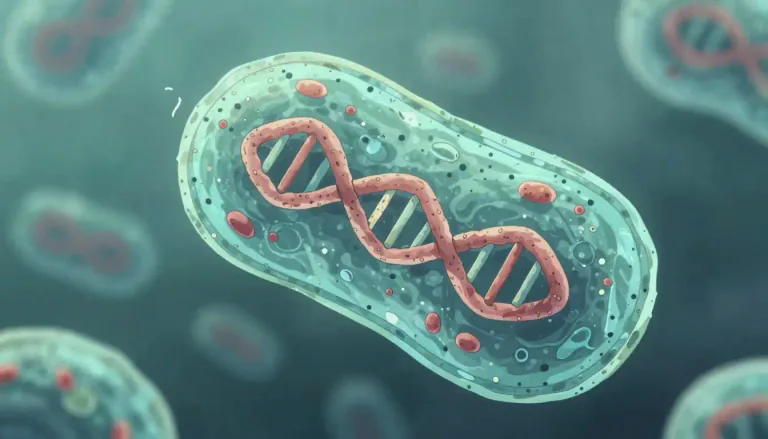
A prokaryote is a simple, unicellular organism that does not have a nucleus or any membrane-bound organelles.
Bacteria are a type of prokaryote that can be found in various environments.
Usage tips
Formal
prokaryotic cell,prokaryotic organism,prokaryotic DNA
noun
A prokaryote is a simple, unicellular organism that does not have a nucleus or any membrane-bound organelles.
Bacteria are a type of prokaryote that can be found in various environments.
Usage tips
Formal
prokaryotic cell,prokaryotic organism,prokaryotic DNA
Definition 1 of 1
 Pro Tip 1/3
Understanding Structure
Prokaryotes have a simpler cell structure compared to eukaryotes, which can help in discussions about evolution.
Many types of medical treatments target prokaryotic cells.
Pro Tip 2/3Recognizing Diversity
Prokaryotes can be found in extreme environments, showing their adaptability.
Different prokaryotes can be beneficial or harmful to humans.
Pro Tip 3/3Contextual Usage
Use 'prokaryote' in scientific discussions rather than casual conversations, as it is more technical.
When discussing cellular biology, always clarify the distinction between prokaryotes and eukaryotes.
Pro Tip 1/3Understanding Structure
Prokaryotes have a simpler cell structure compared to eukaryotes, which can help in discussions about evolution.
Many types of medical treatments target prokaryotic cells.
Pro Tip 2/3Recognizing Diversity
Prokaryotes can be found in extreme environments, showing their adaptability.
Different prokaryotes can be beneficial or harmful to humans.
Pro Tip 3/3Contextual Usage
Use 'prokaryote' in scientific discussions rather than casual conversations, as it is more technical.
When discussing cellular biology, always clarify the distinction between prokaryotes and eukaryotes.
Pro Tip 1/3Understanding Structure
Prokaryotes have a simpler cell structure compared to eukaryotes, which can help in discussions about evolution.
Many types of medical treatments target prokaryotic cells.
Pro Tip 2/3Recognizing Diversity
Prokaryotes can be found in extreme environments, showing their adaptability.
Different prokaryotes can be beneficial or harmful to humans.
Pro Tip 3/3Contextual Usage
Use 'prokaryote' in scientific discussions rather than casual conversations, as it is more technical.
When discussing cellular biology, always clarify the distinction between prokaryotes and eukaryotes.
Never forget "Prokaryote"
Humans forget easily. That's why you should download WordUp: Smart reminders, word games, AI practice, and much more!





WordUp Chrome Extension
As you browse the web instantly look up words you don’t know.
Get Chrome Extension