Muon
noun
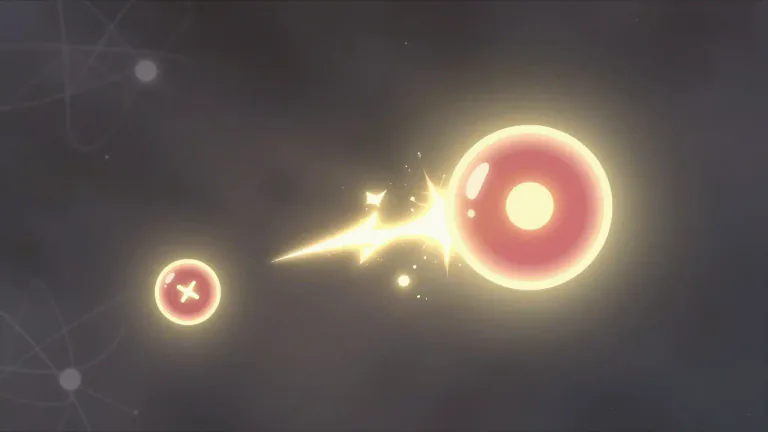
A muon is a subatomic particle similar to an electron, with a negative electric charge and a much greater mass.
Muons are created when cosmic rays interact with the Earth's atmosphere.
Usage tips
Neutral
decay of muons,muon neutrino,muon capture
noun
A muon is a subatomic particle similar to an electron, with a negative electric charge and a much greater mass.
Muons are created when cosmic rays interact with the Earth's atmosphere.
Usage tips
Neutral
decay of muons,muon neutrino,muon capture
Definition 1 of 1
 Pro Tip 1/3
Scientific Context
Muons are essential in exploring particle physics, so they are often discussed in academic settings.
In particle physics experiments, muons are studied to understand fundamental forces.
Pro Tip 2/3Common Misconception
Some may confuse muons for more familiar particles like electrons, although muons are heavier.
Understanding the mass difference helps clarify their unique behavior.
Pro Tip 3/3Experimental Significance
Muons are instrumental in experiments that test theories of particle physics.
Their properties are crucial for validating scientific hypotheses.
Pro Tip 1/3Scientific Context
Muons are essential in exploring particle physics, so they are often discussed in academic settings.
In particle physics experiments, muons are studied to understand fundamental forces.
Pro Tip 2/3Common Misconception
Some may confuse muons for more familiar particles like electrons, although muons are heavier.
Understanding the mass difference helps clarify their unique behavior.
Pro Tip 3/3Experimental Significance
Muons are instrumental in experiments that test theories of particle physics.
Their properties are crucial for validating scientific hypotheses.
Pro Tip 1/3Scientific Context
Muons are essential in exploring particle physics, so they are often discussed in academic settings.
In particle physics experiments, muons are studied to understand fundamental forces.
Pro Tip 2/3Common Misconception
Some may confuse muons for more familiar particles like electrons, although muons are heavier.
Understanding the mass difference helps clarify their unique behavior.
Pro Tip 3/3Experimental Significance
Muons are instrumental in experiments that test theories of particle physics.
Their properties are crucial for validating scientific hypotheses.
Never forget "Muon"
Humans forget easily. That's why you should download WordUp: Smart reminders, word games, AI practice, and much more!





WordUp Chrome Extension
As you browse the web instantly look up words you don’t know.
Get Chrome Extension